Every run below is a docking run, in HADDOCK or AlphaFold 3. The molecular
dynamics trajectories are a separate set of nine systems, listed on the
Molecular Dynamics page; K8Q and K18R appear
here as docking runs and were never simulated.
Y156CUnpaired cysteines removedV293TPLP binding test
Three sprints in full
Alanine substitution
Methodology
Our interface map for BoPEP4 (Brassica oleracea plant elicitor peptide) was built with one validated docking pose, residues buried, salt bridges measured, contacts listed at a 4.5 Å cutoff. It says which side chains sit against PEPR1. It cannot say what the interface loses if one is removed, and by late July that was the question the engineering panel needed answered, because every proposed substitution and every truncation was about to assume a position was expendable.
An alanine scan answers it with a perturbation, not a measurement. Delete one side chain, let the complex relax, record what the energy function says, and repeat at every position. The ranking that comes out is produced by a method sharing no assumptions with a burial calculation, so agreement between them is evidence and disagreement is a question.
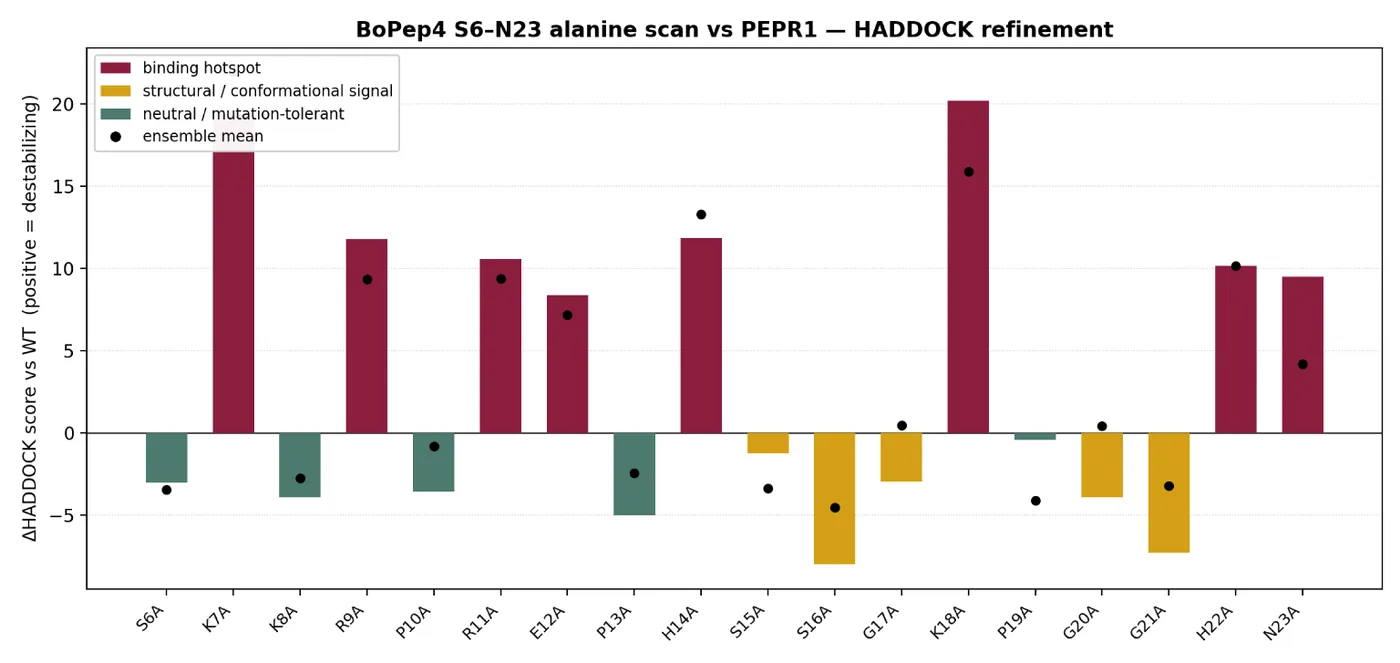
Eighteen single-point mutants, Ser6 through the C-terminal Asn23, were built on the validated native-mode complex and not predicted from scratch: side-chain atoms beyond Cβ deleted, backbone and Cα-Cβ geometry held fixed. Mutating on a fixed pose is what isolates the cost of the substitution; re-docking each mutant would have let it find an unrelated register and returned a number about that instead. All 19 systems, 18 mutants plus an unmutated baseline reused from trunc1-23_PEPR1, went through identical HADDOCK 2.5 water refinement at 40/10/10 with the same restraints, so score differences are attributable to the mutation. Electrostatic and van der Waals terms were kept separate, to tell a lost salt bridge from lost packing, and peptide backbone deviation was recorded as a pose metric independent of the score. All 18 completed.
Results Key results 6 findings
Eight hotspots that fail the same way. K7, R9, R11, E12, H14, K18, H22 and N23 clear +7 on both metrics, and every one is carried by a large positive ΔEelec, from +32.6 at H14 to +150.4 at K18, with ΔEvdw flat or favourable throughout. That is the signature of removing a charged side chain from a salt bridge, and it rules out a packing artefact introduced by the mutagenesis. K18A and K7A are the largest hits. K7A is also the only mutant that moves the peptide, by 1.62 Å, so it costs binding energy and pose retention together.
Cross-validation at 13 of 13. Of the positions where the interface map made an unambiguous call, eight anchors and five non-contacts, the scan agrees with all of them. Two methods with no shared assumptions returned the same interface.
Asn23 ranks last of the eight hotspots. N23A is +9.5, which sits oddly against Asn23 having the largest buried surface at 170 Å2 and four hydrogen bonds. The explanation the data support is that several of those contacts engage the C-terminal carboxylate and backbone amide, not the side-chain atoms an Asn to Ala substitution removes, so part of the clamp survives. That distinction is what the C-terminal tag question turned on later: substituting at position 23 keeps the chain terminus, appending to it does not.
Ser15 and Ser16 disagree with their own conservation. Both are invariant across all 16 characterised Pep-family sequences, and across all 17 when BoPEP4 itself is counted, and were assigned as core hydrogen-bonded contacts. Neither registers, at −1.3 and −8.0. A serine hydroxyl contributes little to an electrostatic term next to a full salt bridge, so the conservation is real and this assay is not positioned to explain it.
The scan would not have found our own two controls. S15A and G17A are the loss-of-function constructs we ordered, on published activities roughly 100-fold and more than 4000-fold below wild type. The scan returns −1.3 and −2.9 at exactly those positions. A method that misses the two substitutions the published work shows matter most is a method whose silence elsewhere carries no weight, which is the same conclusion the July audit of HADDOCK and AlphaFold3 reached by a different route.
The glycines move and the prolines do not. G20A and G21A show the largest backbone deviations in the set, 1.21 and 1.42 Å, with no score effect, consistent with glycine accommodating dihedrals an alanine cannot. The hypothesis floated before the run, that the prolines would show the same signature from losing backbone rigidity, failed: P10A, P13A and P19A sit at 0.75 to 1.03 Å, inside the neutral range.
Results Project 5 findings
ReLEAF has to produce a protectant, secrete it and get it onto a plant. This scan is the sprint that established the binding site is not where that work happens, and it did so by naming the positions that are closed.
The scan closed the binding site and opened the construct. Eight positions are protected as binding-critical, and five more, S15, S16, G17, G20 and G21, are protected on conservation grounds even without a score penalty. With the C terminus already off-limits, the surface left to engineer is the construct and the delivery. Every subsequent design decision in the project sits there.
The secretion handle now has direct evidence under it. S6, K8, P10, P13 and P19 are neutral on both metrics. K8 is the residue the K8Q and K8E secretion designs modify, and until this sprint that choice rested on the burial map alone. The project's limiting problem is secretion efficiency, so a free handle at K8 is a project-level result and not a structural footnote.
The truncation direction was set here. Flat response at S6, plus the map's finding that residues 1 to 6 make no contact, pointed at the N terminus as the removable end. Given the biomanufacturing strategy, the gain was taken as truncation and not substitution, which produced the ladder and then the 9-23 construct: a third less mass, one trypsin-type site instead of three, half the positive charge, so less of it binding electrostatically to the producer cells.
K18R got its rationale here, and losing it cost nothing. K18 carries the largest electrostatic contribution in the peptide, which is what made a conservative Lys to Arg swap attractive. MD later found the Lys18 contact with Asp348 present in 53.7% of frames over a 2.55 to 9.37 Å swing, and Phe371 nearest Gly20, not Lys18. Position 18 still matters; the structural claim underneath K18R does not, and it was not ordered. Because the engineering target had already moved to the construct, withdrawing it removed nothing from the panel.
PEPR2 is not covered. Existing data show PEPR2 with a degraded mid-belt where Arg11 and Glu12 lose their partners, so R11A and E12A may behave differently there. A PEPR2 scan has not been run, and dual-receptor engagement is a ReLEAF-level claim, so it stays open.
Truncation ladder
Methodology
The alanine scan had just told us which positions the interface cannot lose, and by implication which it can: S6, K8, P10, P13 and P19 neutral on both metrics, with the map putting residues 1 to 6 outside the contact region entirely. That licenses editing the N terminus. It does not tell you where to cut.
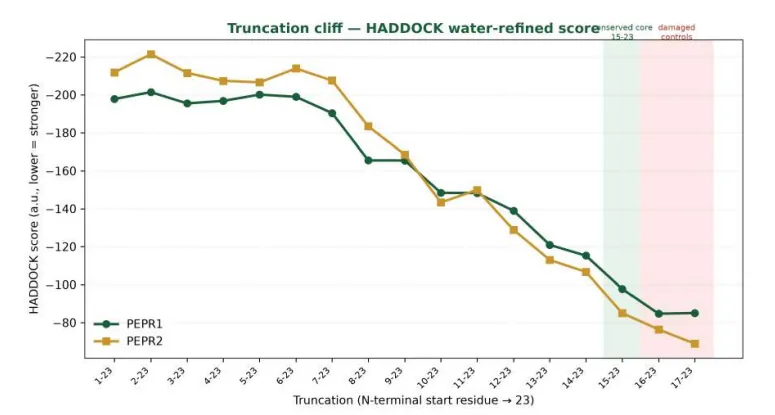
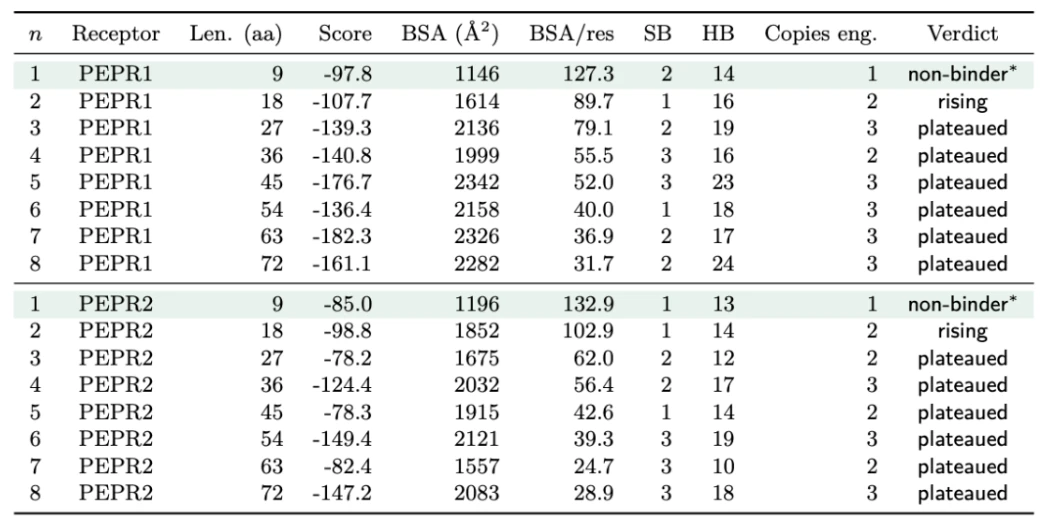
The distinction matters because a substitution and a truncation are not the same experiment. A point mutation removes one side chain and leaves the chain. A truncation removes residues, shortens the peptide, changes its net charge, and moves the N terminus to a new residue that now carries a free α-amino group. Our methodology had no way to predict which of those consequences dominates, so the series was run as a ladder: cut at successive points, score each one on the same protocol, and find where the interface stops tolerating it.
Two things made this the sprint the project needed, not a curiosity. The published work already reports the 9-23 core retaining activity within a factor of ten, so a short form was known to be viable and the question was only which short form. And the manufacturing case was strong enough that if the binding cost were tolerable, the decision was already made. The ladder existed to find out whether it was tolerable, and where.
Results Key results 4 findings
The anchor belt lies downstream of the cut. The atlas established the architecture the ladder is cutting into: an extended peptide clipped into an acidic LRR groove by a three-point salt-bridge belt at Arg9, Lys7/Lys8 and position 18, with the buried Asn23 anchor at the end. The first belt residue is Lys7. Shaving the N terminus removes only Gly1 to Leu3, which make no anchor contact, and the belt is retained intact in every truncated complex.
The shallow truncations were the strongest binders in the panel. Δ1-2 and Δ1-3 came out ahead of both substitutions on AF3 confidence against PEPR1, ipTM 0.88 and 0.89 against 0.82 for K18R and 0.83 for K8Q, with the lowest interface PAE in the set at 1.62 Å for Δ1-3. HADDOCK agreed directionally at −207 and −201. Position 18 keeps its canonical partner through the cut, at 2.77 and 2.85 Å. Removing the anchorless N terminus costs nothing measurable, which is the structural licence for treating N-terminal length as an engineering axis.
The series then moved past them. Δ1-2 and Δ1-3 were the July finalists and are not what we ordered. Shaving two or three residues buys almost no manufacturing benefit while keeping the disordered N-terminal segment that contributes little binding, so the cut moved down the ladder to 9-23, with 7-23 alongside it. Δ1-2 and Δ1-3 were dropped on that reasoning, not on a binding result.
MD located the boundary, and then moved it. The wild-type run put the fluctuation break at the same residue the ladder's cliff falls on: Gly1 fluctuating by 3.51 Å, everything from Glu12 onward under 1.0 Å, and Arg9 at the boundary with an RMSF of 1.32 Å, a mean closest approach of 2.79 Å and 100% contact occupancy. Two methods with no shared assumptions landed on Arg9. The truncation runs then complicated it: clamp integrity is 100.0% for 1-23, 98.5% for 7-23 and 99.9% for 15-23, but 77.1% for 9-23. The cliff is real and it is not where length predicts, because 9-23 keeps the 9-14 segment while removing the Lys7-Asp129 salt bridge that anchors it, and 15-23 removes both together. Shorter is not worse; losing an anchor without the segment it anchors is worse.
Results Project 4 findings
The ladder produced the production molecule. 9-23 is the manufacturing candidate and the construct already in hand as D-01 and D-04. Against full length it carries 33% less mass, 1,612.73 Da against 2,409.74 Da, one trypsin-type cut site instead of three, and half the positive charge at +2.1 against +4.1, so less of it sticks electrostatically to the producer cells. It also removes the greasy GILI front segment, which is the part that raises a self-toxicity risk in B. subtilis, where no amount of promoter tuning would recover the yield. The cost is the published factor of ten in activity.
Settling the question at the bench costs nothing. Both lengths were ordered, 9-23 as D-01 and D-04 and full length as D-03 and D-05, so the head-to-head titre is a comparison we can already run in one sitting. That is the clearest example in the project of a dry lab result shaped so the wet lab can decide it.
The engineering moved away from the binding site. With the C terminus off-limits and the eight hotspots protected, N-terminal length was the only axis left that changes the molecule's manufacturability without touching the interface. The truncation series is what established that axis, and the later tag-placement result depends on it: the N terminus is the end that flaps and the end the ladder shows is removable, so it is where a tag can sit without touching a contact.
One decision is still unresolved. 7-23 is more stable than 9-23 on every MD metric we have, with clamp integrity 98.5% against 77.1%, Asn23-Arg487 99.9% against 81.1%, and 151 receptor contacts against 129. It is also not in our construct set. If the 9-23 deficit holds, the production candidate and the dry lab's best truncation are different molecules.
Tandem repeat analysis
Methodology
The alanine scan and the truncation ladder both ask what the receptor needs. The alignment asks what the peptide family keeps, which is a different and cheaper question: every position that is invariant across a family has been held there by selection, and selection sees the whole job, not only docking.
We needed that because our methods had failed on exactly this axis. The 30 July audit found the HADDOCK score 93% explainable by length and charge and uncorrelated with measured activity, and AF3 unable to separate BoPEP4 from a peptide more than 4000-fold dead. Conservation is the one line of evidence in the sprint that is independent of both, since it is observation and not prediction.
Tandem repeats were the same week's second question. If a single copy engages one receptor, two copies on one chain might engage two, and for a production platform a potency gain per molecule secreted is worth more than a binding gain.
Results Key results 5 findings
The conserved region stops at 20, not 23. We have been describing 15 to 23 as the conserved block. The alignment supports an invariant SSG at 15 to 17 and an invariant Gly at 20, with 21, 22 and 23 variable. BoPEP4's own Gly21 is a minority residue at that position.
Asn23 is not invariant in our set. All seven characterised AtPEPs carry Asn there, and so does BoPEP4, but five of the nine Brassica entries do not: BnPep4_E5L6 has Ser, BnPep6_DM88 has Asp, and the three Pep1 orthologs end in His. BnPep4_E5L6 is BoPEP4's closest relative at two differences. The defensible sentence is that Asn23 is invariant across the characterised AtPEP set and 12 of 17 in our Brassica-inclusive alignment, which is not what our pages currently say.
The invariant positions are the ones the docking score ignores. This is the finding that ties the sprints together. The alanine scan returned −1.3, −8.0, −2.9 and −3.9 at S15, S16, G17 and G20: no penalty at any of the four positions the family has never changed. Published work puts S15A at roughly 100-fold and G17A at more than 4000-fold weaker, and Tang reports G20A harmless while G20I kills binding. So the invariant block is held by selection for something a binding-energy refinement does not measure, most likely backbone register or a step after engagement. Conservation and docking score are answering different questions, and the conserved block is where they visibly disagree.
BoPEP4 aligns to AtPEP1 gapless, 10 of 17 ordered positions identical, at mature 7, 9, 12, 15, 16, 17, 19, 20, 22 and 23. Every identity falls inside the 7 to 23 region. The confirmed figure matches what the MD page already states.
Tandem repeats cannot work for this peptide, on chemistry. Only the final copy in a tandem chain has a free C-terminal carboxylate. In every upstream copy that carboxylate is consumed into the peptide bond joining it to the next copy, and that carboxylate is what salt-bridges Arg487 at 100% occupancy inside a 0.54 Å window. An n-copy construct therefore carries n−1 copies that cannot engage, which is the same mechanism that kills a C-terminal His tag. The groove compounds it: Asn23 sits buried in a pocket at the end of the run with no exit channel, so there is nowhere for a linker to thread out. A linker placed further upstream to avoid that lands inside the invariant 15 to 20 block.
Results Project 4 findings
Multivalency is closed as a potency route. Yield per litre and length per molecule are the levers that remain, which is where the truncation decision came from. No tandem construct is in the panel, and this is the reason to give.
A second independent route reaches the same tag conclusion. The tandem argument and the 6xHis result rest on one chemical fact about chain ends. The codon-optimised cassettes designed in June and July append CATCATCATCATCATCAT directly after the mature peptide, so the tag sits on exactly that carboxylate; the constructs ordered after 16 August carry the tag at the N terminus instead. Two analyses reaching it by different routes is why tag placement moved to the front instead of being treated as a modelling caveat.
Support for the crop-range claim. BrPep4_A5G1 differs from BoPEP4 by one residue and BnPep4_E5L6 by two, so the Brassica Pep4 orthologs are effectively the same molecule. A peptide designed for one Brassica crop is not obviously specific to it, which is the in-silico support under the crop-range experiment.
The assay controls gained a rationale beyond the literature. S15 and G17 are two of the four positions the family has never changed, which is a stronger reason to expect them to break than a transferred activity figure alone.
Reading a docking score
This series is the one place in the project where the scoring function is measuring the variable under test, and the record should say so plainly.
Our own methodology audit on 30 July found that the HADDOCK score across BoPEP4 variants is 93% explainable by peptide length and net charge alone, and that its correlation with Pearce's measured activities is rho ≈ +0.05, where zero is no relationship. A truncation ladder changes length and net charge at every rung: 23 residues at +4.1 down to 15 residues at +2.1. So the ladder's score differences are being produced by the two quantities the audit identified as the score's actual content, and a monotone trend across the ladder would be uninformative no matter which direction it ran.
A second case is sharper, because it is a failure, not a confound. The K8Q+K18R double collapses on PEPR1 by every geometric measure available: AF3 ipTM 0.49 against 0.75 to 0.89 for the rest of the panel, interface PAE 9.45 Å against 1.62 to 2.78 Å, the fewest receptor contacts at 42, nine hydrogen bonds against 16 to 21 elsewhere, and a position-18 anchor that has slipped off Asp320 onto Glu296 at a broken 3.42 Å. HADDOCK scores that complex −194.7, which sits inside the −187 to −218 band occupied by the nine healthy complexes. The matrix logs it as DISCORDANT-HADDOCK-rescues. The function looked at a mis-registered interface with half the hydrogen bonds and called it normal.
Two consequences follow, and both are already in the methodology.
The score is interpretable within a protocol and not across ligands. The alanine scan is the favourable case: same receptor, same restraints, same length, same charge, one side chain removed from one fixed pose, so a score difference has nowhere else to come from. The ladder is the unfavourable case, which is why the cliffs are reported as a hypothesis about which residues matter and not as a measurement of how much binding is lost.
And it is why the load-bearing evidence moved. Where the cliff claim now rests is geometry and occupancy, not score: the salt-bridge inventory showing which bridges dissolve at which cut, and then contact occupancy over 30 ns showing which of those bridges were held and which were only sampled. Both were measured on the same ladder. Neither is a HADDOCK score. The ladder picked the cut points worth simulating, which is what a confounded ranking can honestly be used for.